


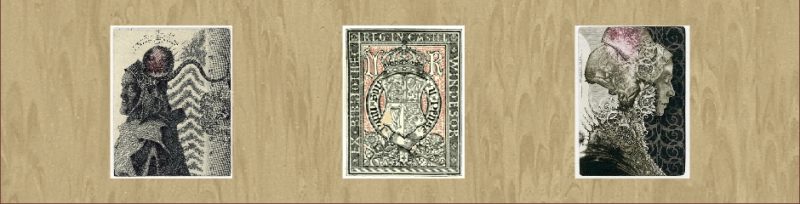


The Art of the Bookplate

A bookplate represents pride in the ownership of books. Since the fifteenth century, distinguished artists and their patrons have given serious attention to this art form. It is a miniature graphic art print developed to adorn books providing a convenient, individualized way for the book’s owner to be identified. The bookplate, or ex libris, is a label affixed to the inside front cover of a book.
Bookplates have been designed by artists and engravers such as Albrecht Dürer, Thomas Bewick, Paul Revere, Kate Greenaway, Aubrey Beardsley, Marc Chagall, M.C. Escher, Rockwell Kent, Leonard Baskin, Barry Moser, and others. Many are acknowledged for their work as book illustrators and designers. For example, Rockwell Kent made numerous contributions as book illustrator, designer and author. He was perhaps one of the most popular American bookplate artists of the century. Another important and prolific artist was Leonard Baskin, who was best known as sculptor and printmaker. He illustrated many books and created bookplates.
The owners of bookplates are a distinguished group as well. We find that Queen Victoria of Great Britain owned a bookplate, as did George Washington, Franklin D. Roosevelt and Charles DeGaulle. Other famous people include: Harpo Marx, James Cagney, Sigmund Freud, Walt Disney, J.P. Morgan, Jack London, and the list goes on.
Many techniques and mediums are used in their creation. Some include the woodcut, engraving on metal, silk-screen, etching or pen and ink. This, along with the fact that the work is all done in small scale, plays an important part in the execution of these works. Also, utilizing the finest in papers, with hand printing in many examples.
Both institutions and individuals are patrons of this graphic art. For an institution, such as a public or private library, university, law firm or museum, the interest is in identifying a specific collection of books or multiple collections. The librarian may want to mark the time when a book was added to a collection or illustrate a special interest. For the individual, the motivation for commissioning bookplates includes this reason, along with the desire to own beautiful pieces of art, and in many cases development of an interest in collecting this art as a hobby.
Bookplate collecting began more than a century ago and has spread to most parts of the world. Idiosyncratic to this art form alone, most collections are built through the exchange of duplicate pieces. This is accomplished when collectors have one or several personal designs, in fact some collectors have hundreds specifically made for the purpose of trading with others. The goal is to increase the size and scope of their holdings. Most often these collections are organized according to artist, theme, technique, country and/or period. In an exploration of the art one will learn of vast numbers of ex libris that have been amassed, even some collections numbering the hundreds of thousands.
Ex libris enthusiasts have created an international network for the purposes of attaining designs by establishing societies in over forty nations. Through participation in these societies worldwide friendships can grow. Every two years an International Ex Libris Congress is held in a different country inviting members of the world bookplate societies to attend. Under the auspices of the Federation International des Societes d’Amateurs d’Ex Libris (FISAE) one enjoys lectures, slide presentations, exhibitions and sufficient time is allowed for socializing and trading bookplates. This provides endless opportunities for artists and collectors to acquaint themselves with the interest and enthusiasm for this art form in other countries.
In the United States, the American Society of Bookplate Collectors and Designers (ASBC&D) was organized in 1922 to further the study and collecting of bookplates. Today, the ASBC&D membership includes more than 150 individuals and 50 institutions. The purposes of the ASBC&D as stated in the first Year Book are: “To cultivate the spirit of friendship and mutual helpfulness among collectors and designers of bookplates; and to assist in the further development of the bookplate.” This is accomplished by the publication of a Year Book, quarterly newsletter and exchange lists. There are many foreign ex libris associations with whom the Society corresponds and exchanges publications.